
The Bilistick® System 2.0
Bilirubin measurement, close to the newborn. A portable reader and a small blood sample provide a result at the point of care.
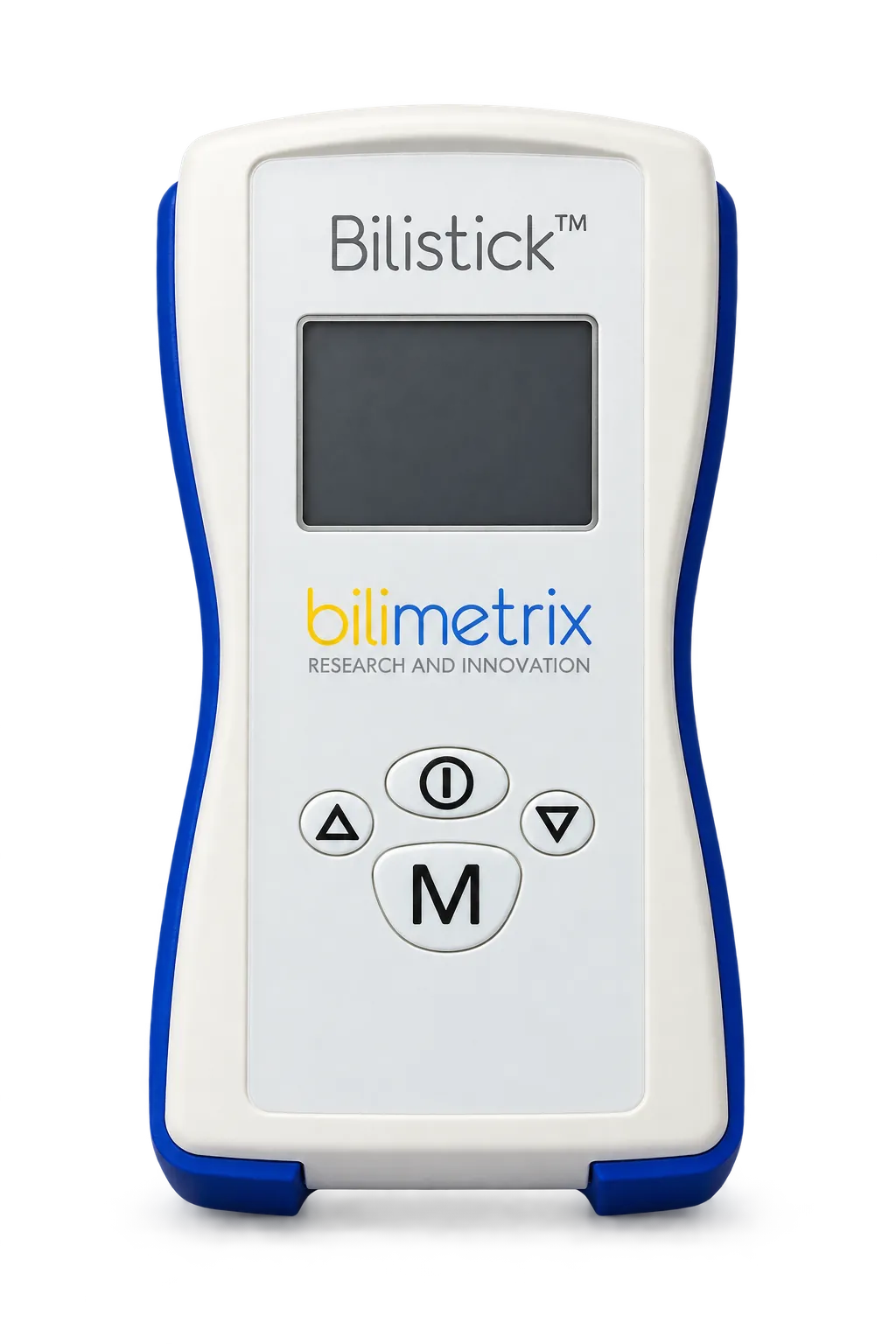
Three components. One measurement.
Each component has a specific function: collect the sample, separate the plasma and measure bilirubin.
The Bilistick® Reader
A reflectance reader powered by a rechargeable battery. It analyses the test strip and displays the bilirubin concentration.
220 g · Colour displayBilistick® Test Strip
The cassette contains a cell-plasma separator and a reading membrane. It is inserted into the reader before the sample is applied.
48.65 × 15 × 3.70 mmBilistick® Sample Transfer Pipette
Transfers the required blood volume onto the test strip, collected from a heel stick or a test tube.
Drawing capacity: 35 µLSchematic representations of components, not to scale.
From sample to result.
Four stages within one system. Select a stage to explore how it works.
Insert the Test Strip
Insert the test strip into the reader before applying the blood sample. The reader automatically performs the blank reading required for measurement.
Apply the sample
Using the dedicated transfer pipette, apply 35 µL of fresh capillary whole blood to the strip already inserted into the Reader. The small sample volume helps minimize the invasiveness of the procedure.
Plasma reaches the reading area
The strip separates plasma from blood cells, allowing it to reach the reading area. The Reader measures total bilirubin by reflectance photometry, without the addition of reagents.
The concentration is displayed.
The Reader displays the total bilirubin concentration in mg/dL or µmol/L. The measurement is completed in under 100 seconds, with the exact time depending on the sample hematocrit.
Descriptive diagram: refer to the user manual and required training to perform the test.
Separate the plasma.
Read the bilirubin.
The test strip combines sample preparation and the reading surface. The reader measures light reflected from the membrane to determine total bilirubin concentration.
- 465 / 570 nm
- The two wavelengths used by the photometric system.
- No reagents
- No additional reagents are required for the measurement.
System data.
Specifications stated in the BM-BS 2.0 technical data sheet, Rev. 5 — 02/2021.
- 35 µL
- Sample volume
- < 2 min
- Test time¹
- 220 g
- Reader net weight
- 1–40 mg/dL
- Measurement range
In the clinical pathway
Designed for use by trained healthcare professionals under physician order, the Bilistick® System 2.0 provides quantitative total bilirubin results at the point of care to support the assessment and monitoring of neonatal hyperbilirubinemia. Results should be interpreted alongside the newborn’s clinical condition and applicable clinical guidelines.
Download the data sheet| Parameter | Specification |
|---|---|
| Sample type | Newborn whole blood |
| Sample hematocrit | 25–70% |
| Measurement range | 1–40 mg/dL / 17–684 µmol/L |
| Displayed units | mg/dL and µmol/L |
| Measurement system | Photometric, at 465 and 570 nm |
| Resolution | ± 0.1 mg/dL / 1.0 µmol/L |
| Reader dimensions | 31.3 × 72.9 × 140 mm (H × W × D) |
| Connectivity | Mini B-USB; LAN via USB/RJ45 adapter; Wi-Fi via USB dongle |
| Integration | Connection to the hospital network using HL7 protocol |
| Operating conditions | 15–40 °C / humidity 15–90% |
¹ Test time depends on hematocrit. See the data sheet for the complete specifications and conditions.