Neonatal jaundice
Common in the first days.
Important to recognise.
A yellow colour can signal a temporary change. Understanding when it needs attention means understanding bilirubin, measuring it and interpreting it in the newborn’s clinical context.
The first week in numbers.
- 60%
- of full-term newbornsdevelop jaundice in their first week of life.
- 80%
- of premature newbornsdevelop jaundice during the same period.
Approximate estimates reported by NICE. These describe the frequency of jaundice, not of severe cases. [2]
What causes the yellow colour?
Jaundice is the visible sign of bilirubin accumulating in the body. Its appearance alone does not reveal the underlying cause or indicate the severity of the condition.
Bilirubin is a yellow pigment produced during the normal breakdown of red blood cells. During the first days of life, a newborn’s liver may not eliminate it quickly enough. The resulting build-up gives the skin and the whites of the eyes their characteristic yellow colour.
Most neonatal jaundice is temporary and resolves without treatment. In some cases, however, it may be associated with conditions requiring further investigation. Visual observation, bilirubin measurement and clinical assessment should therefore be considered together.
Production
The breakdown of red blood cells produces bilirubin.
Removal
The liver helps process and remove it from the body.
Accumulation
When production and removal do not balance, bilirubin rises.
Common does not always mean harmless.
The clinical priority is to identify newborns whose bilirubin levels are approaching or have reached potentially dangerous concentrations.
Severe hyperbilirubinemia, if not treated promptly, can damage the nervous system. Kernicterus is a permanent form of bilirubin-induced brain injury and may cause movement disorders, hearing loss and other neurological disabilities.
Although this is not the usual outcome of neonatal jaundice, it is the serious complication that makes timely recognition, bilirubin measurement and appropriate management essential.
Three approaches. Three distinct roles.
Clinical practice uses different approaches to identify jaundice and assess bilirubin levels. Each provides different information and has specific conditions of use. The type of result, the care setting and the organisation of the service determine its role in the clinical pathway.
Recognise a sign Visual inspection
Helps recognise jaundice but does not quantify bilirubin. The colour change can be harder to identify on darker skin.
To considerAppearance alone cannot estimate bilirubin levels; observation needs to be complemented by measurement when indicated. [4]
Estimate through the skin Transcutaneous measurement
Estimates bilirubin through the skin without a blood sample and can provide an immediate result.
To considerIt is a screening tool: particular conditions or elevated values require confirmation with a blood test, according to guidelines. [5]
Measure in blood Blood testing
Measuring bilirubin in blood forms part of diagnostic investigation and clinical assessment.
To considerAccess to sampling, sample handling and result availability depend on service organisation. When the laboratory is distant, these steps require coordination. [1]
A value must be interpreted alongside age in hours, gestational age and other risk factors. [4]
The sample pathway matters too.
- Blood collection
- Sample handling
- Analysis
- Report
- Small sample
- Reader on site
- Result
Simplified organisational pathways. Transport, actual steps and timings depend on the setting and method used.
From pathway needs
to measurement on site.
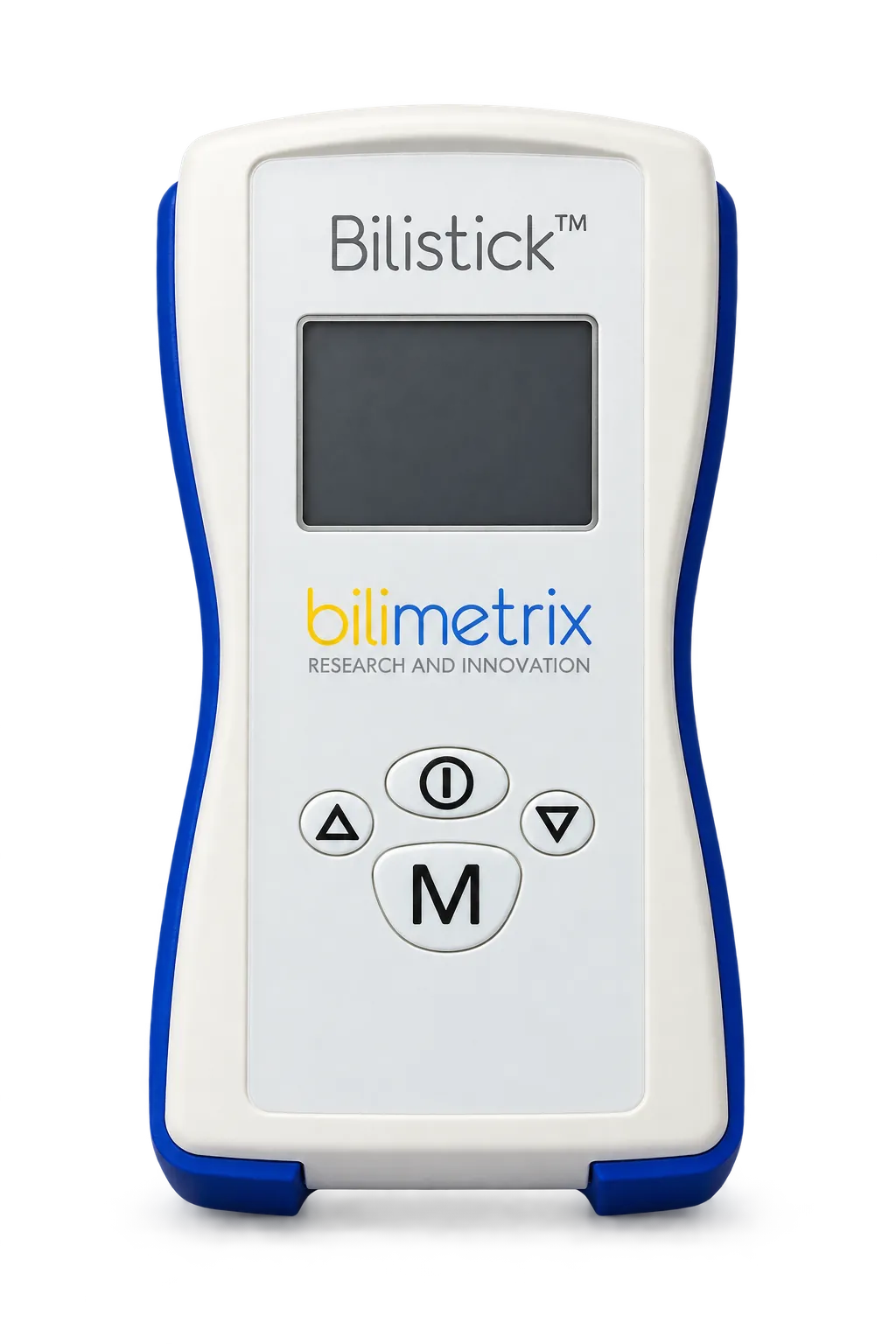
Bilistick® introduces a Point-of-Care blood measurement: a portable reader analyses the sample close to the newborn. Its features address specific operational needs while clinical assessment remains essential.
A quantitative whole-blood measurement
The Bilistick® System 2.0 quantitatively measures total bilirubin using 35 µL of fresh capillary whole blood. As a blood sample is required, the procedure is minimally invasive.
A portable, rechargeable battery-powered Reader
Weighing 220 g, the Reader enables total bilirubin measurement near the point of care, without sending the sample to a central laboratory. It is designed for use by trained healthcare professionals in the intended clinical settings.
Analysis in under 100 seconds
The Reader displays the total bilirubin concentration in mg/dL or µmol/L. The analysis time varies with the sample hematocrit and does not include sample collection or preparation.
Assessment does not end with the first observation
Continuity from the birth setting through discharge and subsequent follow-up is an essential part of newborn care. The American Academy of Pediatrics (AAP) provides specific recommendations for bilirubin assessment before discharge and post-discharge follow-up in newborns of at least 35 weeks’ gestation.’ gestation. [6]
In the birth setting
Recognise jaundice and gather the information needed for clinical assessment.
Before discharge
Combine the bilirubin value with risk assessment and planning for subsequent checks.
During follow-up
Ensure access to reassessment and the checks indicated for the individual newborn.
Technology and data,
in detail.
Explore how the Bilistick® System 2.0 works, the measurement sequence and the technical specifications stated in the product documentation.
Discover the Bilistick® System 2.0Sources and references
- NHS — Jaundice in babies
- NICE — Neonatal jaundice: frequency in the first week
- CDC — Developmental disability basics: kernicterus
- NICE CG98 — Jaundice in newborn babies: recommendations
- NICE QS57 — Measurement of bilirubin after 24 hours
- AAP — Hyperbilirubinemia: guidance and follow-up
- Bilistick® System 2.0 — Technical Data Sheet, Rev. 5, 02/2021